Women's Hormone Balance is Dependent on Nitric Oxide

Gender roles create different expectations and behaviors in men and women that affect chronic disease incidence and outcomes, including tobacco use, exercise and treatment-seeking. Women tend to be affected by chronic diseases at younger ages than men. Women typically live longer than men but do so with greater disability and less social protection than men.
As daughters, sisters, and informal workers; women are often the main and long-term health-care providers for those that suffer with chronic disease. This in turn, puts an additional burden and stress on them that can lead to the onset and/or faster progression of disease. The women in our lives are constantly balancing their careers and household duties, often putting their health and well-being on the backburner as a result.
This comes with consequences. There are sources of toxicity in the world we live in that disrupts hormone balance and affects our vascular health.
Hormone balance helps regulate and control specific physiological responses. As our endothelial health suffers, we cannot make sufficient nitric oxide. Without adequate hormone balance and good circulation, health begins to decline, symptoms develop and women are unable to keep up their normal pace of life.
 IMAGE SOURCE: https://drnathansbryan.com/wp-content/uploads/2022/05/hemodynamics-orgasm.jpg
As you can see from the graph, the first step in this process in an increase in blood volume. Nitric oxide is required to dilate the blood vessels that can lead to increased blood volume. Without nitric oxide production, the other events and increase in pressure cannot and will not occur. Consequently, women become anorgasmic.
IMAGE SOURCE: https://drnathansbryan.com/wp-content/uploads/2022/05/hemodynamics-orgasm.jpg
As you can see from the graph, the first step in this process in an increase in blood volume. Nitric oxide is required to dilate the blood vessels that can lead to increased blood volume. Without nitric oxide production, the other events and increase in pressure cannot and will not occur. Consequently, women become anorgasmic.
SYMPTOMS OF INADEQUATE HORMONE BALANCE AND POOR CIRCULATION
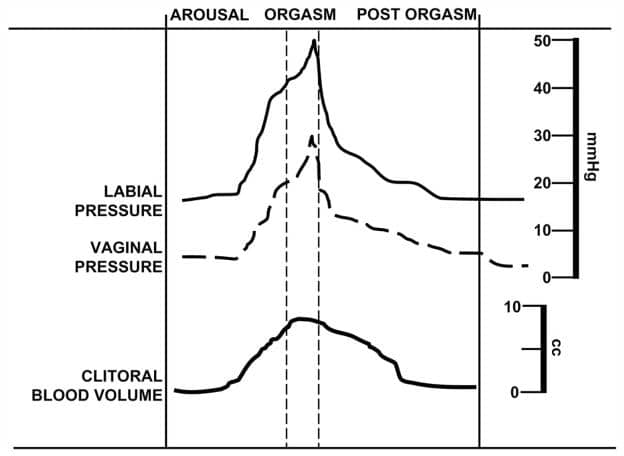
One of the first symptoms to appear in women is female sexual arousal disorder. Female sexual arousal disorder is the persistent/recurring decrease in sexual desire or arousal, diminished vaginal lubrication, difficulty/inability to achieve an orgasm and feeling of pain during intercourse. In 1978, more than 76% of women reported some symptom of sexual dysfunction. Today some reports show 18-76% of women have some form of inhibited orgasms. Sexual arousal and orgasm is an exquisite and finely controlled process. There must be an increase in vaginal blood flow leading to clitoral engorgement, labial engorgement and vestibular bulb engorgement. The graph below shows the time course and hemodynamics of a normal orgasm.
IMAGE SOURCE: https://drnathansbryan.com/wp-content/uploads/2022/05/hemodynamics-orgasm.jpg
As you can see from the graph, the first step in this process in an increase in blood volume. Nitric oxide is required to dilate the blood vessels that can lead to increased blood volume. Without nitric oxide production, the other events and increase in pressure cannot and will not occur. Consequently, women become anorgasmic.